Deja Vu
ディジャヴ
- Year
- 1990
- Developer
- ICOM Simulations / Kemco
- Publisher
- Kemco / Seika
- Platform
- FC / NES
- Hardware
- Family Computer (8-bit)
- Genre
- Point-and-click adventure
- Players
- 1 player
- Controls
- D-pad/cursor + A (select) / B (cancel)
- Series
- MacVenture series
Gameplay Screenshots
About This Game
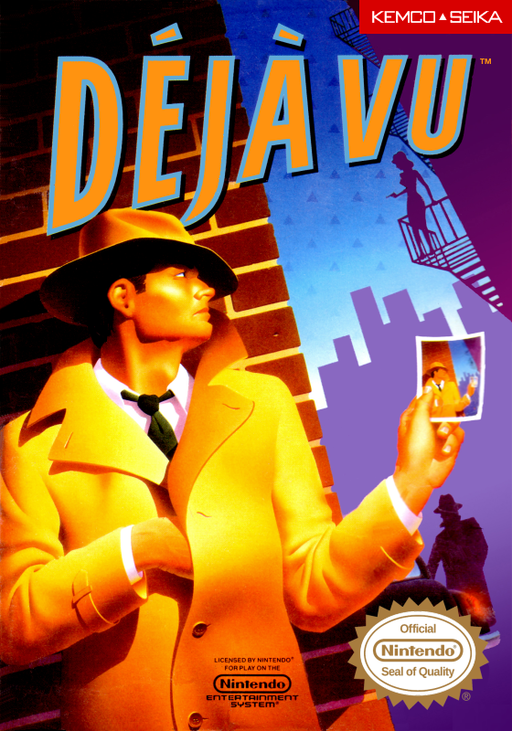
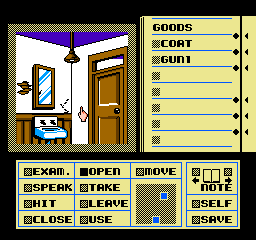
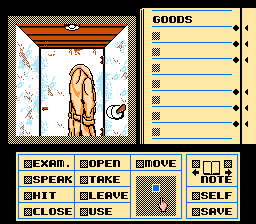
Deja Vu opens with you waking up in a bar bathroom with no memory, a split lip, a gun in your pocket and a dead man somewhere in the building. You have a name you have to work out and a frame you have to beat.
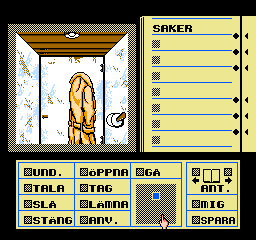
It is the second of the MacVenture games and it plays like a hard-boiled detective novel, using the same verb-and-cursor interface as Shadowgate but with an important addition: a clock. Actions take time, the city has a day/night cycle, and if you fail to piece together what happened before the deadline, you are convicted of the murder. That turns exploration into triage, because some leads expire and some objects disappear while you are elsewhere. Where Shadowgate punishes you with traps, Deja Vu punishes you with wasted hours, and its multiple endings depend on whether you solve the case at all rather than just on which door you picked.
- Amnesia premise in which your own identity is a puzzle to solve
- A running clock with a day/night cycle and a hard deadline
- Leads and items that expire if you are slow to follow them
- Multiple endings determined by how much of the case you actually solve
Version History
- Macintosh original1985
The original MacVenture release by ICOM Simulations.
- Famicom Japanese version1988-11-22
Japanese console release by Kemco, two years ahead of the US NES version.
- NES US version1990-12
The version on this page, published by Seika.
Tips & Strategy
Search the bathroom completely first
The opening room carries more items than it looks like it does, and leaving without them costs a trip you cannot afford.
Interview everyone before searching anywhere
People move and their information has a window. Talking first means the objects you find later have somewhere to point.
Write down every name
The game asks you to identify people and places by name. Keeping a written list is faster and safer than trusting recall.
Budget the clock per location
Travelling costs time. Clearing one destination fully beats checking three of them half-way.
Download Resources
Resource packs for this game are provided through the button below.
⬇ Coming soonSimilar Games
Browse all: FC Games