Lode Runner
ロードランナー
- Year
- 1984
- Developer
- Broderbund / Hudson Soft
- Publisher
- Hudson Soft (JP) / Broderbund (US)
- Platform
- FC / NES
- Hardware
- Family Computer (8-bit)
- Genre
- Puzzle platformer
- Players
- 1 player
- Controls
- D-pad + A / B
- Series
- Lode Runner series
Gameplay Screenshots
About This Game
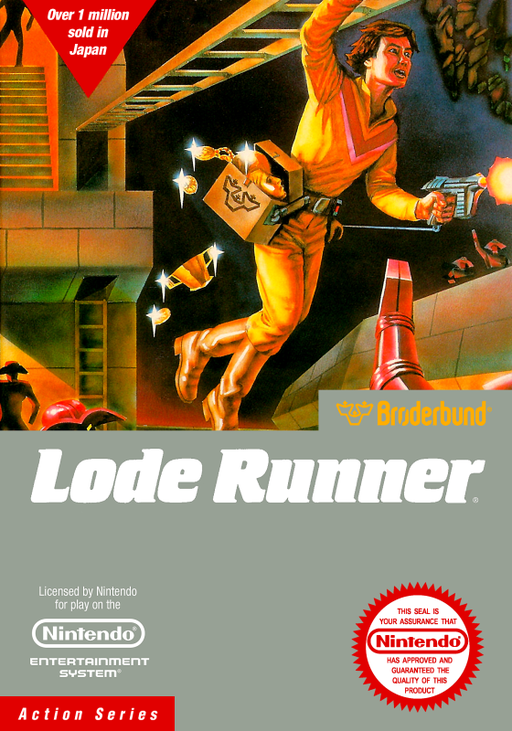
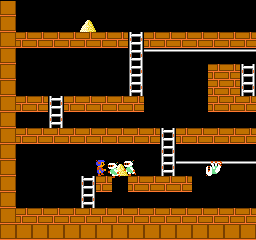
Lode Runner is a puzzle game disguised as an action game, and it is the reason a whole genre of digging-and-trapping games exists. You are a runner in a brick maze, and the goal is simply to collect every gold bar without being caught.
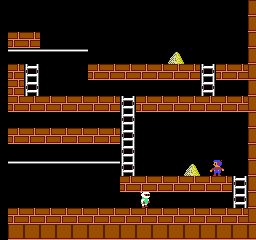
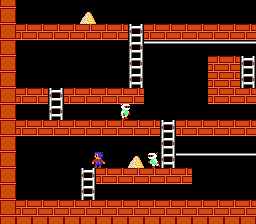
What makes that more than a chase is the digging. You cannot jump, but you can burn a hole through the floor to your left or right, and anything standing on that tile falls in. Dig two holes side by side and an enemy drops into the first one, walks out and falls into the second, and if you fill the hole while it is still inside, the enemy is buried for a few seconds - the only way you will ever get the last few bars in a tight corner. Because you fall into your own holes too, every escape route you make can also trap you. The Famicom conversion by Hudson Soft arrived in 1984 and added something the computer originals did not have: a level editor, so players could build and save their own stages. Its 50 stages are laid out as a difficulty curve rather than a random pile, and the late ones are genuinely mathematical.
- Dig-through-floors movement - no jump button exists
- Trap enemies in your own holes and bury them to buy time
- 50 Famicom stages arranged as a deliberate difficulty curve
- A built-in level editor, unusual for a 1984 console cartridge
Version History
- Apple II original1983
Doug Smith's original, published by Broderbund, with 150 stages.
- Famicom Japanese version1984-07-31
Hudson Soft's conversion with 50 stages and a level editor.
- NES US version1987-09
The version on this page, published by Broderbund.
Tips & Strategy
Dig escape routes before you need them
A hole takes a moment to burn. Preparing the tile you intend to retreat through is what separates a plan from a panic.
Bury, do not run
Filling a hole with an enemy inside takes it out of the level for several seconds. On crowded stages that pause is worth more than any amount of speed.
Take the corners first
Corner gold is the hardest to reach once enemies have spread out. Clearing the edges early keeps the middle open for the endgame.
Watch your own holes
Every hole you dig is a hole you can fall into. Running back the way you came is the most common way a clean stage ends.
Download Resources
Resource packs for this game are provided through the button below.
⬇ Coming soonSimilar Games
Browse all: FC Games